

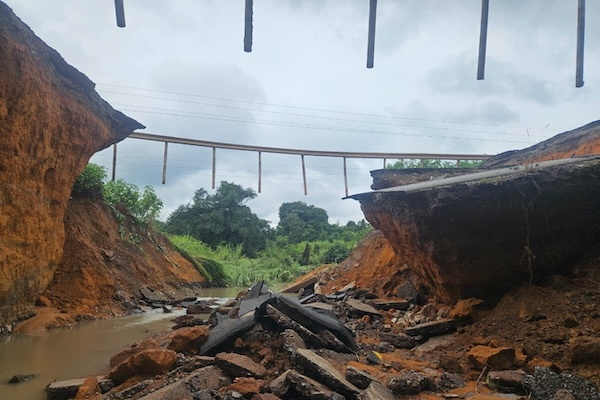


The vital logistics artery connecting the Democratic Republic of Congo (DRC) to international markets came to a grinding halt this weekend. The collapse of a strategic bridge in Zambian territory, triggered by severe flooding, has disrupted traffic on the region’s primary copper export corridor. This major infrastructure failure occurs as the DRC solidifies its position as the world’s second-largest producer of the red metal.
The Kasumbalesa border, a crucial crossing point between the DRC and Zambia, is the busiest in the region. It serves as the bottleneck through which nearly all mining production from the Greater Katanga region transits toward Southern African ports. Any disruption on this axis has immediate repercussions on global delivery schedules and operational costs for mining companies active in the African Copperbelt.
According to an official statement from the Zambia Revenue Authority (ZRA) released Sunday, water damage has completely impacted traffic to and from the Kasumbalesa border. Transporters, whose truck queues often stretch for dozens of kilometers, are currently forced to seek alternative routes, which are frequently longer and more expensive.
Zambia’s Road Development Agency (RDA) indicated that emergency repairs began on Sunday. Authorities aim to restore provisional access within 48 hours. Images broadcast by the national channel ZNBC show the intensity of the floods, with the structure literally washed away by the water.
For the DRC, this disruption is critical. As the world’s second-largest copper producer, the country relies heavily on the fluidity of its exports to fuel public revenue. This latest logistical incident highlights the vulnerability of the current supply chain. The blockage of thousands of tons of copper concentrates and cathodes at the borders results in direct losses for transporters and increases pressure on international buyers’ inventories.
This incident sharply revives the debate over excessive dependence on the Southern corridor. To mitigate these risks, several major projects are under development. The Lobito Corridor, supported by the United States and the European Union, aims to link Congolese mines to the Angolan Atlantic port by rail, offering a shorter alternative. Meanwhile, China is investing $1.4 billion to revitalize the TAZARA railway line toward the port of Dar es Salaam in Tanzania. The diversification of these export routes is now seen not as a luxury, but as a strategic necessity for the stability of the African mining sector.
M&B