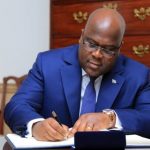



President Félix-Antoine Tshisekedi signed into law on March 14, 2026 the legislation establishing the Economic and Financial Criminal Court (TPEF) and its attached General Prosecutor’s Office. The Democratic Republic of Congo now has a dedicated jurisdiction for prosecuting economic crimes, financial fraud and corruption — a reform championed for years by former Justice Minister Constant Mutamba.
Announcement Broadcast on National Television
The announcement was made on Saturday evening through an ordinance read on the national broadcaster RTNC. The text establishes both the Economic and Financial Criminal Court and a General Prosecutor’s Office attached to the new jurisdiction.
Justice Minister Guillaume Ngefa welcomed the promulgation on March 15, 2026, describing it as one of the “major milestones” of the presidential mandate in consolidating the rule of law. According to Ngefa, the President had instructed him from the very start of his tenure to bring to completion a process that had been repeatedly postponed, both in Parliament and at the Council of Ministers level.
A Purpose-Built Judicial Architecture
The TPEF operates with functional autonomy and an independent budget drawn from the national budget. Structurally, it comprises two chambers: a court of first instance and an appeals chamber. The first instance chamber sits with three judges — one career judge and two assessor judges — and is itself divided into five specialised sections.
These five sections cover: monetary counterfeiting and forgery; offences related to electronic payment instruments; financial regulations; corruption, embezzlement and public procurement; and offences in the telecommunications sector.
The law provides for a General Prosecutor attached to the TPEF, whose rank will be equivalent to that of a General Prosecutor at the Court of Cassation — a provision intended, according to the reform’s architects, to guarantee the court’s institutional independence.
A Long-Gestating Reform
The roots of this reform go back to 2022. It was Inspector General of Finance Jules Alingete who first called for the creation of a specialised economic and financial criminal tribunal, arguing that ordinary courts had demonstrated their limitations in handling complex financial crime cases. The idea received the support of President Tshisekedi in December 2023. When Constant Mutamba took office as Justice Minister, he made the project a priority.
The bill was adopted by the government at the 40th session of the Council of Ministers, held on April 18, 2025 in Lubumbashi, Haut-Katanga province. Mutamba argued at the time that the legislation would “strengthen institutional cooperation between specialised investigative, prosecutorial and adjudicatory bodies”, describing it as a decisive step toward a more credible and technically capable justice system.
A Reinforced Anti-Corruption Arsenal — But Questions Remain
The TPEF’s creation is part of a broader accumulation of anti-corruption mechanisms. The new court joins the Inspectorate General of Finance (IGF), the Court of Auditors, and the economic and financial intelligence unit of the National Intelligence Agency, operational since August 2024.
Whether the court will deliver results remains to be seen. For many observers, the specialised court could prove a decisive lever for restoring public confidence in the justice system and strengthening institutional credibility. Others point to the DRC’s long record of institutional announcements without operational follow-through.
The context carries its own irony: Constant Mutamba, the law’s principal architect, is himself facing trial at the Court of Cassation on allegations of embezzlement. The TPEF’s real value will be measured not by its legal architecture, but by its actual independence from political pressure — and by the state’s willingness to provide it with the human and financial resources it requires to function.
M&B