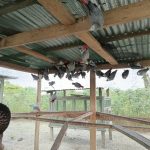

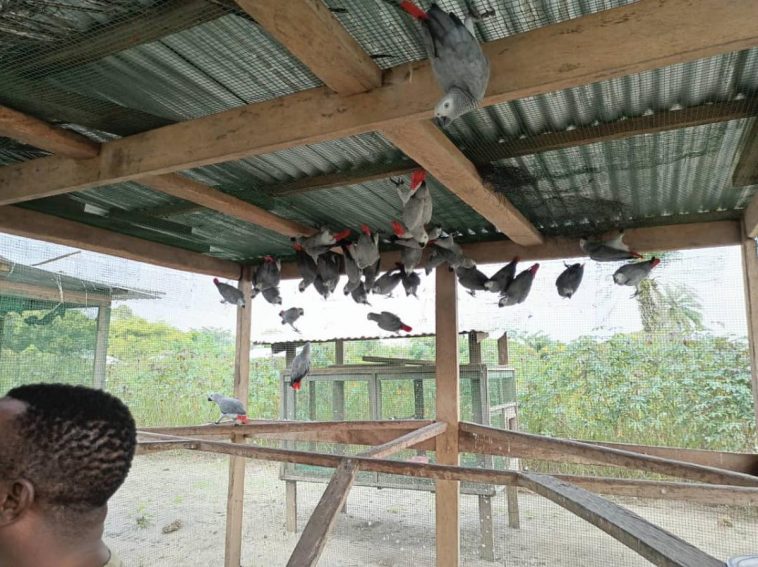

Fifteen African grey parrots, rescued from the hands of traffickers, were released into their natural habitat in Maniema on Sunday, March 15.
That same week, two ivory traffickers were arrested seven kilometers from Kindu.
The release operation, led by the Lukuru Foundation in partnership with the Congolese Institute for Nature Conservation (ICCN), took place at the Dingi rehabilitation center in the Bangengele chiefdom, Kailo territory. Eighty-eight other parrots, deemed unfit to return to the forest, are being kept there for care and monitoring.
The reintroduction process follows a rigorous protocol. “We check the parrots: left wing, right wing, we count the feathers, we check the tail and the body condition. Those that are ready to fly are placed in the aviary. The feathers must have grown back well,” explains Ibra Kitshwanda, the head of the center, which has been operational since 2023.
The African grey parrot (Psittacus erithacus), highly prized on the global pet market for its vocal mimicry abilities, is classified as “endangered” by the International Union for Conservation of Nature (IUCN). The DRC is home to one of the last large wild populations of the species.
Ivory trafficking: ICCN warns of “massive destruction”
Meanwhile, the ICCN and security services arrested two ivory traffickers late last week on the outskirts of Kindu. The site director of the Lomami National Park draws an alarming conclusion.
“We monitor the animals in the forest and observe whether they are multiplying or decreasing. In the four years I have been here, there have been suspicions at our checkpoints and in exit zones, signs of a massive destruction of our biodiversity,” he stated, urging local communities to “keep their eyes open and report these crimes.”
The arrest comes just after a coordination workshop brought together several agencies to strengthen collaboration in the fight against environmental crime in Maniema.
Maniema between conservation and valorization
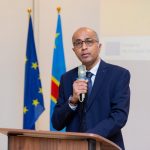
These operations are part of the stated policy of provincial authorities to restore local ecosystems and transform wildlife wealth into an economic lever, notably through ecotourism. The governor of Maniema reaffirmed his determination to turn the province’s protected areas, including those sheltering the grey parrots, into hubs of attraction for investors.
Maniema, a vast forest territory that remains largely landlocked, is still one of the areas most affected by poaching and wildlife trafficking in the DRC, fueled by criminal networks taking advantage of weak controls and the immensity of the forest cover.
M&B with Radio Okapi