
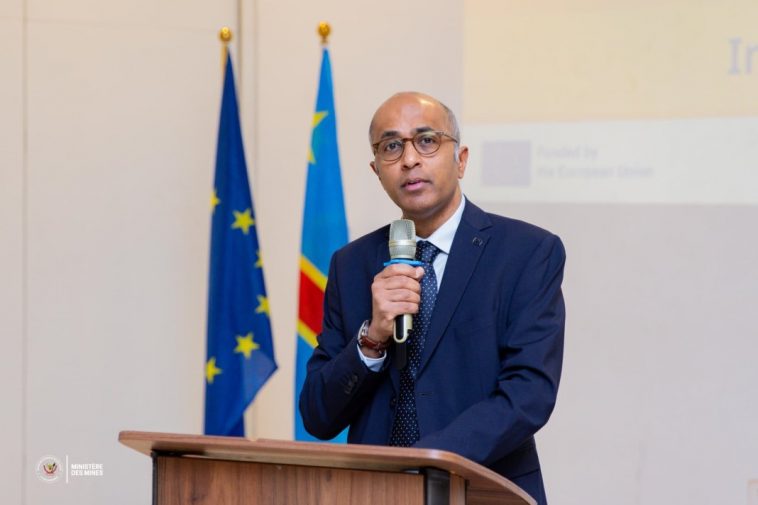


The DRC officially launched, on Tuesday, March 17 in Kinshasa, the PanAfGeo+ INVEST program, the third phase of the European Union’s flagship program dedicated to geoscientific capacity building in Africa. With a funding allocation of 17.8 million euros out of a continental budget of 45.5 million, the DRC is by far the primary beneficiary, receiving nearly four times more than South Africa, the second pilot country (3.8 million euros).
“The DRC is by far the primary showcase country. It shows the emphasis being placed, through this PanAfGeo project which is a continental project, specifically on the DRC today,” declared Jean-Claude Guillaneau, the project coordinator.
6 million for Tervuren
PanAfGeo+ INVEST (2026-2029) is implemented by the French Geological and Mining Research Bureau (BRGM) in partnership with EuroGeoSurveys (EGS) and the Organization of African Geological Surveys (OAGS). It is built around three components: the partnership between European and African geological surveys; training—the two previous phases have already trained 1,773 African experts in various geosciences fields; and an investment component aimed at developing projects in critical metals, from mining to processing, including the artisanal sector.
Out of the overall budget, 6 million euros are reserved for the digitization of the archives of the Royal Museum for Central Africa in Tervuren (Belgium), which houses a portion of the DRC’s historical geological data.
“Strategic tool”
In the DRC, the program is led by the National Geological Service of Congo (SGN-C), attached to the Ministry of Mines, in partnership with the BRGM and “Team Europe”. Its Director General, Raoul Wazenga Vitima, presented knowledge of the subsoil as both a diplomatic and economic lever, stating that the SGN-C’s mission is to produce reliable data to guide public policies and attract responsible investments.
“Geoscientific data constitutes a strategic decision-making tool. It allows us not only to guide investments but also to promote the development of mineral exploration and guarantee a responsible, transparent, and sustainable management of our natural resources,” stressed Minister Watum.
“Mapping opportunities”
The EU Chargé d’affaires insisted on the strategic dimension of the program, which goes beyond the simple collection of geological data. “It is not just about mapping minerals, but mapping opportunities. This is why the national windows opening in the DRC, Namibia, and South Africa will serve as pilots for deepened collaboration between the European Union and Africa,” declared Fabrice Basile, as quoted by Actualité.cd.
The program enters its operational phase on March 19 with the launch of the “Country Window DRC”, a component dedicated to fieldwork, precision mapping, and the modernization of national laboratories.
M&B