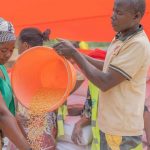



The Democratic Republic of Congo’s second-largest city sits atop one of the planet’s greatest concentrations of copper and cobalt. It hosts mining multinationals worth billions of dollars. It exports critical minerals essential to the global energy transition. And this week, its residents are lining up at markets to pay sixty thousand Congolese francs for a bag of maize flour — twice the usual price — when they can find it at all.
This is the Congolese paradox in its starkest form.
A Sharp Price Spike, A Structural Signal
The current surge is unusually severe. The standard 25-kilogram bag of maize flour — the locally named “breakfast,” a dietary staple in Lubumbashi — jumped from 35,000 to 60,000 Congolese francs within a week, according to market price monitoring in the city. That is a 71% increase in seven days. Individual retail measures have followed the same trajectory.
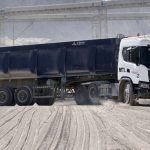
Traders’ explanations converge on a single word: Zambia. Shipments have slowed. Convoys are delayed. Source prices have risen. The mechanism is identical to the 2023 crisis, identical to 2025. It repeats because nothing has structurally resolved it.
Lubumbashi Fed by Lusaka
The Haut-Katanga capital does not produce the maize it consumes. It imports it — overwhelmingly from Zambia, occasionally from South Africa or Tanzania. This is not a secret; it is a documented reality, noted by successive provincial agriculture officials for decades. “The semi-arid countries of the subregion feed us,” summarized one provincial agriculture inspector, in a phrase as damning as it is accurate.
The irony is stark. Zambia now produces 3.7 million metric tons of maize per year, generating a surplus of 1.2 million metric tons and positioning itself as a regional food exporter. This was achieved through a structured input-support program reaching more than one million farmers across 116 districts. Meanwhile, farmers in Haut-Katanga average just 1.5 to 2 tons per hectare, hampered by limited access to fertilizers, improved seeds, and technical support.
The DRC holds an estimated 15 million hectares of arable land in Haut-Katanga alone. Nationally, 75 million hectares of agricultural land have been identified — less than 10% of which is currently cultivated. The constraint is not land. It is the investment that never came.
The Mining Trap
Haut-Katanga’s mining vocation has progressively pushed agriculture down the priority ladder — and out of budget allocations. Mining codes take precedence over agricultural codes in land use. Arable land retreats before mining concessions. Farmers leave the province or migrate across the border to Zambia, where conditions for agricultural production are more favorable.
This imbalance appears on both sides of the frontier. In Zambia itself, mining expansion around the Mopani concessions is generating friction with local agriculture: in 2025, over 60% of farmers near the mine sites reported disruptions to irrigation water access, causing a 9% yield decline in affected areas. Mining extraction and food security are in direct competition — on the Zambian Copperbelt as much as on the Congolese one.
Solutions That Arrive Too Late
Kinshasa has acknowledged the problem. In September 2025, Minister of State for Agriculture Muhindo Nzangi Butondo traveled to Kipushi, in Haut-Katanga, to hand over tractors to farmers in the Grand Katanga region. His message was unambiguous: “In two years, we will produce our own food, and the local market will no longer depend on external sources.”
It is a genuine commitment. It is not the first one. The Haut-Katanga governorate itself launched five agricultural villages covering 30,000 cultivable hectares in 2019, with explicit food self-sufficiency targets. The FAO has deployed a USD 4.5 million agricultural support program in Katanga, funded by Germany. Programs exist. Announcements multiply. And each season, when Zambian convoys slow, Lubumbashi runs short of flour.
The deeper problem is not the absence of policy. It is the absence of transport infrastructure that would make interior production zones — Haut-Lomami, Tanganyika — accessible to urban markets. “Getting to Kamina or Manono can take a month during the rainy season,” provincial administration acknowledges. As long as that month persists, Zambia will remain the breadbasket of the Congolese Copperbelt.
A Systemic Risk Underestimated
Lubumbashi’s social stability is tightly linked to the price of a bag of flour. It is a working-class city, a mining city, where median wages cannot absorb this kind of food price shock. In 2023, when prices exceeded 90,000 francs per bag, market tensions were palpable. The current spike has not yet reached that level — but it occurs against a backdrop of broad household inflationary pressure.
The region supplying the world with critical metals for the energy transition is itself in chronic food vulnerability. This is a systemic risk that mining investors operating in the area are beginning to factor into their social stability assessments. A mining city that cannot eat is a city that simmers.
Toward Food Sovereignty: The Urgency of the Long Game
The DRC possesses every asset needed to feed not only Haut-Katanga but much of southern Africa. Its arable land, water networks, and diverse agro-ecological zones represent an agricultural potential that many countries would envy. That potential has been waiting — since independence — for the public and private investment, transport infrastructure, input policies, and value chains that would allow it to materialize.
The rise in maize flour prices in Lubumbashi is not merely an economic news item. It is a reminder of the unresolved equation at the heart of the Congolese development model: extracting resources from below the ground without building the conditions that allow people to live with dignity above it.
M&B