

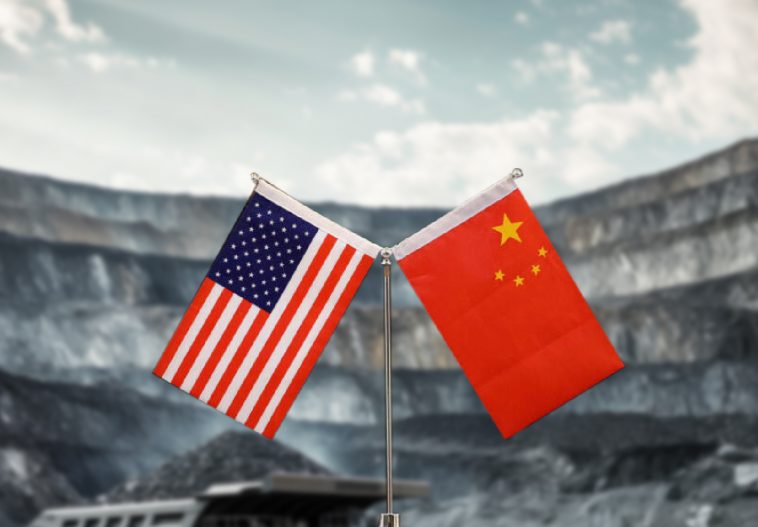


The Congolese authorities and China have signed a new cooperation agreement in the mining sector, the Congolese government announced, while Washington intensifies its own diplomatic offensive to secure access to the country’s strategic minerals. This balancing act confirms Kinshasa’s position as a favored playground in the Sino-American rivalry for critical raw materials.
According to the government press release published on March 26 and reported by Reuters, the agreement covers the sharing of geological data, investment protection, and the promotion of local processing of raw materials on Congolese soil. A monitoring mechanism is planned to ensure that projects “comply with Congolese legislation in a stable and transparent investment environment.” Kinshasa also confirmed that the MIFOR railway and mining project in the northeast of the country will receive priority support from Beijing.
The agreement comes amid a context of increased pressure. Congolese exports to China are already set to enjoy duty-free access starting May 1st, as part of an initiative covering 53 African countries. Chinese companies—CMOC (the world’s top cobalt producer), Zijin, and Huayou—already dominate the Congolese mining sector, and Beijing remains the DRC’s largest bilateral creditor.
Washington Will Not Remain Indifferent
But China is not the only contender in the running. The Trump administration signed a strategic partnership with Kinshasa last December, aiming to stimulate Western investments, redirect flows of critical minerals, and reduce the Chinese stranglehold on their extraction and processing. The DRC has since sent Washington a list of priority assets, while warning that it would turn to other partners if the American agreement did not lead to concrete projects.
For Joshua Walker of New York University’s Congo Research Group, the message of this new agreement with Beijing is unambiguous: “The United States will certainly take note. It is clearly a riposte to Washington.” However, the analyst points out the difference in nature between the two agreements: the understanding with Washington is broader and more binding, combining security support in the east of the country—where Kinshasa has spent years fighting armed groups backed by Kigali—with access to mineral resources.
“The DRC is clearly trying not to put all its eggs in one basket,” Walker concludes.
As the world’s leading producer of cobalt and the holder of vast reserves of copper, lithium, coltan, and other metals crucial to the energy transition, the DRC intends to capitalize on the geopolitical competition for its resources without tying itself exclusively to any single power.
M&B with Reuters (Ange Adihe Kasongo)