
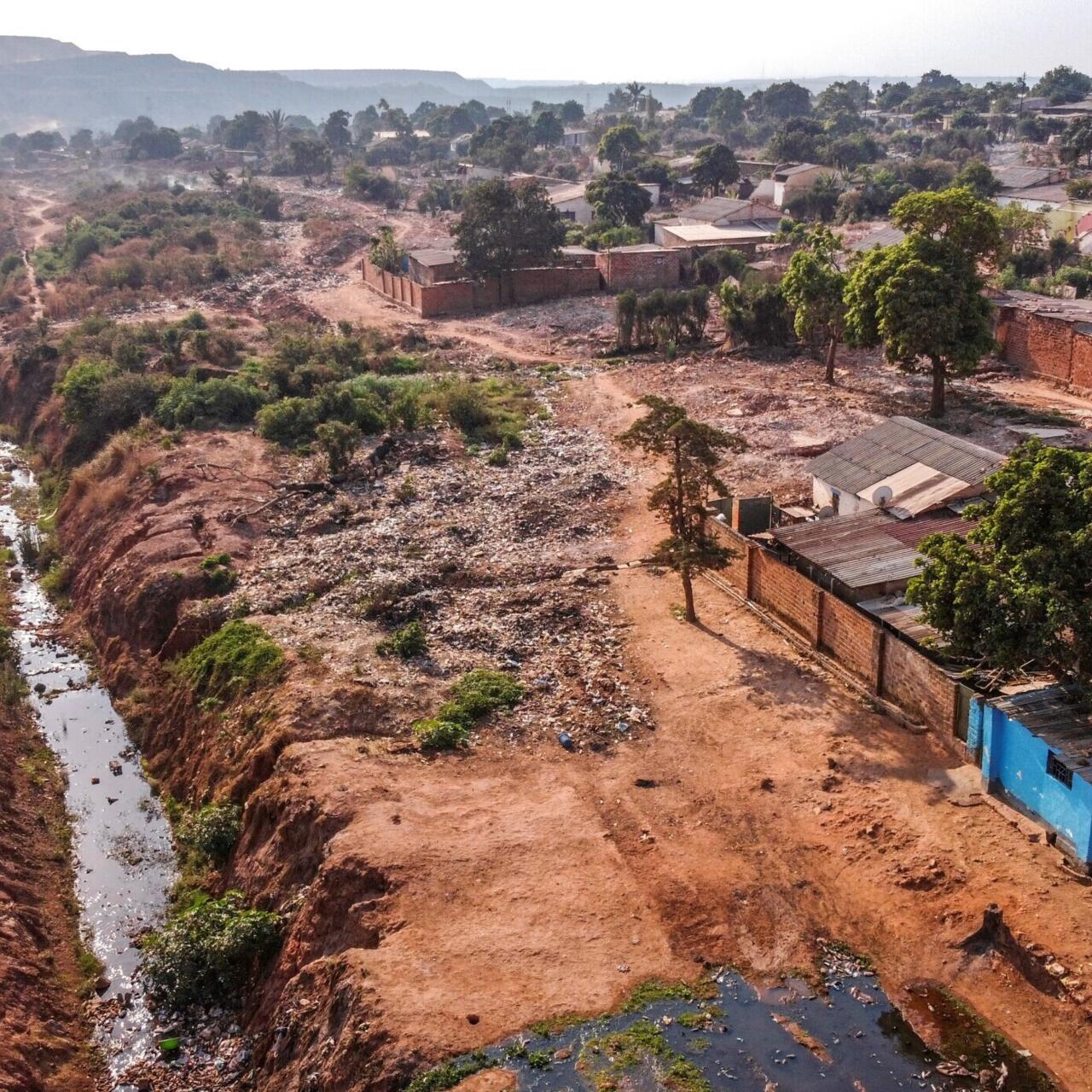
In Musonoï, in the city of Kolwezi, cobalt and copper mining is extending into residential plots. In the Kabila 1 and 2 cells, some families are even abandoning their homes to allow the exploitation of the subsoil. Behind this artisanal mining rush, an entire economy is developing, but so are growing risks for miners and residents.
The landscape of Musonoï is changing rapidly. Holes are appearing in the middle of avenues, while piles of excavated material occupy the open spaces of residential plots.
In some places, access points leading down into the mine shafts are even located inside houses, in living rooms or bedrooms.
On site, shafts sometimes exceeding 70 meters in depth and underground galleries accommodate large numbers of artisanal miners. In some cases, as many as 70 people work on a single shaft. Bags of ore are regularly brought to the surface before being transported by motorcycle or truck to trading posts and then to processing units.
An Economy Built Around Each Shaft
This artisanal mining activity does not benefit miners alone. Each shaft operates according to an organizational system understood by the various parties involved.
The owner of the residential plot provides the space, while the owner of the shaft finances, among other things, the stripping work. The artisanal miners carry out the extraction. To avoid conflicts, the parties agree in advance on how production days will be divided among them.
According to information gathered on site, the owner of the plot receives 10% of gross production. The cooperative responsible for supervising artisanal miners also benefits from this activity. Government services operating in the area also collect taxes.
For its technical interventions, SAEMAPE reportedly collects CDF 100,000 per shaft every Saturday, equivalent to approximately USD 45, according to information gathered on site.
A Profitable but Dangerous Activity
For many families, this mining activity represents an essential source of income. However, working conditions expose miners to significant risks.
“There are cave-ins, and miners die here every day. Last August, we recovered the bodies of these artisanal miners after a shaft collapsed,” a security officer testified.
The weakening of the ground is another concern. Excavations, piles of waste material, and the intensification of mining activities in an area already affected by the industrial operations of COMMUS expose some homes to cracks, subsidence, and collapse.
The Other Side of the Energy Transition
Musonoï is not an isolated case. Similar activities have also been reported in Mutoshi and Kasulu, also in Kolwezi.
As cobalt and copper have become strategic minerals for the global energy transition, their extraction also reveals its downside: behind international demand for critical minerals, some communities live extremely close to extraction areas, with direct consequences for their homes and safety.
In Kolwezi, the question is therefore no longer simply how much cobalt can be extracted, but at what human, social, and environmental cost.
Héritier Maila / La Guardia Magazine
About The Author

Commentaires