
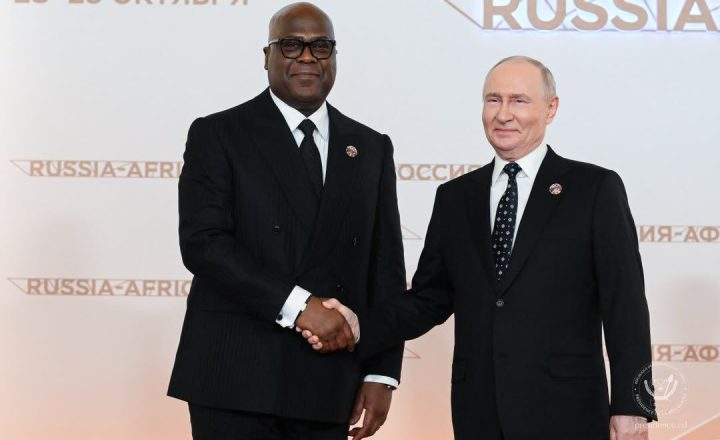
Minerals at the heart of Congolese ambitions
Addressing African and Russian leaders gathered in the Russian capital, Félix Tshisekedi advocated cooperation oriented towards concrete economic results. For the DRC, one of the main challenges is to better add value to its natural resources and turn its mining wealth into a genuine lever for industrialization.
The head of state particularly insisted on the local processing of minerals, an orientation that aligns with Congolese ambitions to develop value chains on national territory. In a country with significant reserves of copper, cobalt, lithium and other strategic resources, the question of industrial partnerships and technology transfer remains crucial.
However, no quantified Russian mining investment or specific mineral processing project was announced in the information published at the end of the summit. The realization of this ambition will therefore depend on technical discussions and the projects that are actually selected.
Energy and infrastructure among priorities
Energy is another major axis of this cooperation. Félix Tshisekedi mentioned the development of the Congolese hydroelectric potential as well as the exploration of civil nuclear energy. These avenues could open prospects for technological and industrial collaboration with Moscow.
The Congolese president also stressed the development of infrastructure capable of better connecting the different regions of the country. Roads, energy equipment and transport infrastructure are essential conditions to support industrial exploitation and facilitate trade.
Agriculture and food security were also presented as priority areas, particularly through the development of agricultural production and access to fertilizers.
Three agreements to structure the partnership
On the sidelines of the summit, Kinshasa and Moscow strengthened their cooperation by signing three bilateral agreements. These concern in particular the creation of an intergovernmental commission and the development of exchanges in the fields of health and education.
In the health sector, a memorandum concluded for five years provides prospects for collaboration in medical training, research, disease prevention, nuclear medicine and the digitalization of health services.
During his meeting with Vladimir Putin on 30 October at the Kremlin, Félix Tshisekedi reaffirmed the DRC’s willingness to diversify its international partners without renouncing its decision-making autonomy.
For the Congolese economic sector, the real challenge now begins after the signatures: identifying priority projects, mobilizing financing, specifying implementation schedules and guaranteeing the participation of local companies.
The rapprochement between Kinshasa and Moscow thus opens prospects in several strategic sectors. But its economic scope will be measured above all by the realization of projects, the investments mobilized and the jobs generated in the Democratic Republic of Congo.
MB / ASSOCIATED PRESS
About The Author

Commentaires