
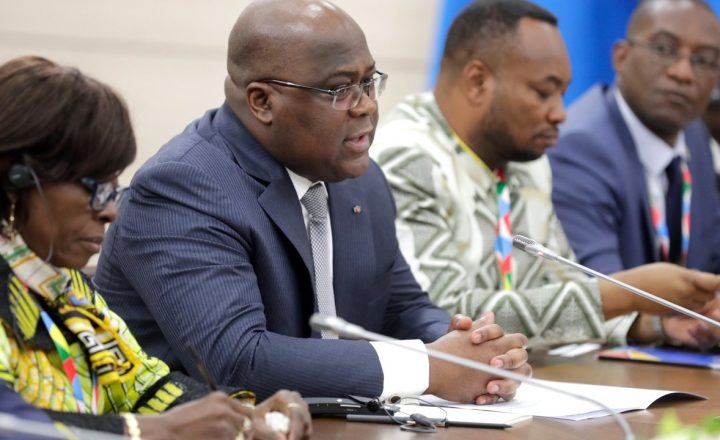
President Félix Tshisekedi wants to strengthen control over mining resources by placing the General Inspectorate of Mines (IGM) under the direct authority of the Presidency of the Republic. Announced at the Council of Ministers of 20 November 2026, the reform aims to improve coordination of controls, reduce illicit channels and protect State revenue.
The Democratic Republic of Congo intends to take a new step in the fight against mining fraud. At the 103rd meeting of the Council of Ministers, President Félix Tshisekedi announced the forthcoming attachment of the General Inspectorate of Mines (IGM) to the Presidency of the Republic. The decision reflects a desire to strengthen the authority and operational capacity of this oversight body, in a sector that is strategic for public finances and the national economy.
Created by Decree No. 23/19 of 9 June 2023, the IGM is a public service endowed with administrative and financial autonomy, until now placed under the authority of the Ministry of Mines. Its missions include monitoring mining activities, combating fraud and smuggling, and strengthening the traceability of mining products, from production sites to export points.
Despite this framework, fraudulent practices continue to concern the Congolese authorities. The Head of State believes they deprive the Public Treasury of significant revenue, undermine the country’s economic sovereignty and encourage the growth of networks operating outside mining legislation.
Revealing seizures in the sector
To justify the reform, Félix Tshisekedi notably cited the findings of a recent mission by the inter-agency commission, particularly in Lualaba province. Operations carried out at several sites led to the seizure of hundreds of trucks and machines, as well as large quantities of ore, mainly copper and cobalt. These seizures are part of investigations into alleged fraud and illegal mining.
The President of the Republic also recalled his earlier instructions. At the 87th meeting of the Council of Ministers on 24 April 2026, he had called for stronger mechanisms to combat the illicit exploitation of natural resources. On 10 July, at the 94th meeting, he had ordered the immediate withdrawal of soldiers and other uniformed personnel illegally deployed at mining sites.
A reform expected on the ground
Attaching the IGM to the Presidency should allow better coordination among the public services concerned, greater operational independence of inspections and direct transmission of strategic information to the Head of State. It should also speed up corrective measures and the application of the sanctions provided for by law.
Prime Minister Judith Suminwa Tuluka and the Minister of Mines have been tasked with taking the legal and administrative steps needed to implement the reform. They have been given 45 days to submit an implementation report.
Beyond the change of oversight, the challenge is to turn monitoring mechanisms into measurable results: fewer fraudulent exports, better traceability of minerals, cleaner trade channels and improved mobilisation of public revenue.
For the DRC, whose copper and cobalt occupy a central place in global supply chains, the credibility of mining governance is also a matter of attractiveness to investors. It now remains to be shown that this institutional strengthening will allow better control of natural resources and allow the national economy to benefit more from their exploitation.
Héritier Maila
About The Author

Commentaires