
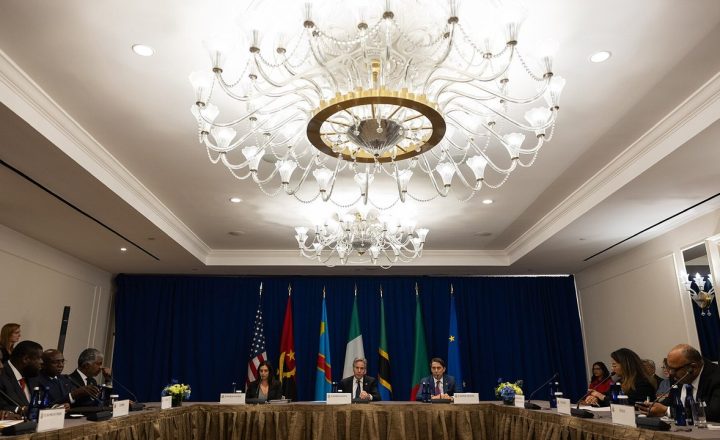
Signed on 4 December 2025 in Washington, the strategic partnership between the Democratic Republic of Congo and the United States is beginning to deliver its first results. A shipment of 12,000 tonnes of copper has joined the US critical minerals stockpile. Progress has also been made on tax and rail matters. However, the rehabilitation of the Lobito corridor, the financing of Inga 3 and security commitments remain major issues still to be delivered.
12,000 tonnes of copper, a first concrete result
The strategic partnership between Kinshasa and Washington has reached a first milestone in its implementation. On 15 October 2026, the Swiss trader Mercuria announced the delivery of 12,000 tonnes of Congolese copper destined for Project Vault, the US critical minerals stockpile. Presented as a trial shipment, this operation is one of the first tangible commercial results of the agreement concluded between the two countries.
This momentum had been preceded, in January 2026, by Gécamines’ announcement that it was exercising its right to purchase 100,000 tonnes of copper from the annual output of Tenke Fungurume, intended for the American market. At the same time, the US International Development Finance Corporation (DFC) has expressed interest in taking a stake in a joint venture between the Congolese state-owned mining company and Mercuria.
Beyond deliveries, Washington intends to secure its supplies of strategic minerals, while Kinshasa is seeking to attract capital, develop its industrial capacity and strengthen the value added to its natural resources.
Taxation and the Lobito corridor: progress recorded
On the regulatory front, the DRC has also taken an important step. On 7 August 2026, the President of the Republic promulgated the law revising the tax and customs regime applicable to collaboration agreements and cooperation projects. This reform meets one of the deadlines set out in the agreement, which provided for a twelve-month period to adapt the relevant legislation.
In terms of infrastructure, the Lobito corridor is among the flagship projects of this cooperation. On 26 August 2026, the Congolese government signed a concession with the Portuguese company Mota-Engil for the Dilolo–Sakania railway section, the Congolese part of this route linking the Katanga mining basin to the Atlantic Ocean via Angola.
However, while trains are already running, the poor condition of the track limits the network’s performance. The results of the rehabilitation studies are expected in March 2027. The actual timetable for the works therefore remains to be clarified.
Inga 3 and security: major challenges persist
The other major project concerns energy. The Inga 3 hydropower project remains essential to support the DRC’s industrial ambitions, notably the local processing of minerals. A first meeting of the Congolese–American coordination committee was held on 26 October in Paris. On 11 November, the National Assembly declared the bill on Grand Inga admissible.
However, the studies, the financial structuring and the mobilisation of the investment needed for construction have yet to be finalised. The $250 million approved by the World Bank in June 2025 relates to preparing the programme and supporting local communities, not to building the dam.
Finally, security remains a major concern. Despite the cooperation commitments between Kinshasa and Washington, the results expected to stabilise the east of the country have not yet materialised.
As the first anniversary of the agreement approaches, the picture is therefore mixed. The first commercial operations and institutional reforms point to cooperation on the move. But its success will now depend on investments being realised, infrastructure being modernised, access to energy and a lasting improvement in the security situation.
HÉRITIER MAILA / RFI
About The Author

Commentaires