
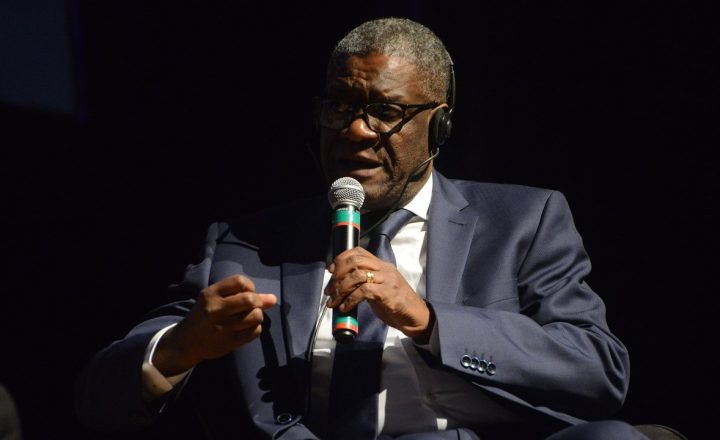
The 2018 Nobel Peace Prize laureate has published a strategic note for lasting peace in Congo. The Mukwege plan combines diplomatic pressure, international justice, the integrity of mineral supply chains and good governance. A strategy meant to be comprehensive, but one that sorely lacks political will.
Dr Denis Mukwege “refuses to resign himself” to a conflict that has been going round in circles for 30 years now in the east of the country. Weary of a peace that never comes, of justice that is still absent and of the total impunity enjoyed by the perpetrators of crimes, the Nobel Peace Prize laureate proposes a detailed crisis-exit scenario for lasting peace in Congo. After an unsuccessful bid in the 2023 presidential election, Denis Mukwege is taking up his pilgrim’s staff again to try to weigh on a conflict for which no one now sees a way out. Since 1996 – the Lemera massacre was commemorated on 6 October – Congo has been plunged into the multiple aggressions of its Rwandan and Ugandan neighbours and of its remote-controlled rebellions with their varied acronyms: AFDL, RCD, MLC, UPC, CNDP, M23, CRP… To which must be added dozens of armed groups: ADF, Red Tabara, CODECO, FDLR…
“A worrying over-militarisation of the region”
The latest “episode” of the conflict is the return to arms of the M23 in early 2022, backed by neighbouring Rwanda. Kigali pleads for the defence of the Tutsi of Congo and the fight against the FDLR, heirs of the 1994 perpetrators of genocide, but in reality, Rwanda makes no secret of its expansionist ambitions to control the East against a backdrop of looting of the mineral resources of the Kivus. The government has bogged itself down in solutions with no future, with the intervention of African regional forces that only managed to bring about “a worrying over-militarisation of the region by various foreign armies far more motivated by geostrategic and commercial interests than by concern to protect civilians and to eliminate the capacity of the rebel armed groups to cause harm”, Denis Mukwege points out. Calling on the Wazalendo armed groups and on the mercenaries of the American Erik Prince has not made up for the weakness of a Congolese army eaten away by corruption.
“Fragmented diplomatic initiatives have fostered a worsening of the situation”
Diplomacy has hardly been more effective in ending the crisis. From Sun City, Lusaka, Addis Ababa and Nairobi, “through the presence of a major peacekeeping mission deployed for more than 25 years, the war has never ended”, the Nobel laureate explains. The latest diplomatic initiatives launched in Nairobi, Luanda, Washington and Doha have not been crowned with any greater success. “The absence of coercive measures and the multiplication of fragmented initiatives have fostered a worsening of the situation and a strategy of fait accompli. The lessons of these failures must be learned,” the Mukwege plan insists, proposing 5 strategic priorities. “The immediate priority must be the full implementation of United Nations Security Council Resolution 2773.” The text demands: an immediate and unconditional ceasefire, the immediate withdrawal of Rwandan troops and of support for the M23, as well as the dismantling of parallel administrations in the rebel-held areas. To ensure its implementation, Denis Mukwege calls for “targeted sanctions against the political and military leaders involved, and stronger monitoring mechanisms for an effective ceasefire”. For now, the sanctions against Kigali have not had the expected effects on the ground.
An international conference and a national dialogue
The second priority would be to organise an international conference for peace in the Great Lakes region. The conference would bring together the signatory States, regional guarantors (African Union, ICGLR, SADC), the United Nations, international partners such as the World Bank, the European Union, the International Contact Group for the Great Lakes, civil society and faith-based groups. The private sector should be called upon to promote a “Business for Peace” approach.
The third initiative is a Congolese national dialogue inspired by the “Social Pact for Peace” of the National Episcopal Conference of Congo (CENCO) and the Church of Christ in Congo (ECC). A national dialogue proposed by Félix Tshisekedi is currently being prepared, but Denis Mukwege regrets that “the initiative does not come from a neutral actor and is not accompanied beforehand by political de-escalation measures”. In view of the security and health situation with the Ebola epidemic, the Nobel laureate asks those in power “to postpone the debate on constitutional revision, in accordance with Articles 219 and 220 of the Constitution of the DRC, in order to avoid a new period of institutional instability that would risk plunging the Nation into a serious political crisis”.
A Special Tribunal for Congo and mixed Congolese chambers
As the fourth cornerstone of the edifice, Dr Mukwege calls for the establishment of transitional justice to fight impunity, with the support of the United Nations and international partners. The crisis-exit plan also calls for cooperation with the Independent Commission of Inquiry on the human rights situation in the provinces of South Kivu and North Kivu mandated by the UN Human Rights Council. It also calls for applying the principle of universal jurisdiction to the most serious crimes committed in the DRC, as in the case of Roger Lumbala, recently convicted by the Paris Assize Court. Finally, the Office of the Prosecutor of the International Criminal Court (ICC) must continue its investigations in the DRC. At the heart of the transitional justice mechanism, Denis Mukwege calls for the establishment of a Special Tribunal for Congo and of mixed chambers within the Congolese courts.
A genuine reform of the mineral supply chain
Finally, since the plundering of Congo’s natural resources fuels the conflict, the Mukwege plan demands a robust reform of mineral supply and processing chains. The text calls for a strengthened international traceability system, transparency obligations for companies, and local processing of minerals to create added value and make Congolese people benefit from it. “In addition, it would be important to include structural reforms to correct the economic incentives that fuel illegal exploitation.” The 5 measures proposed by Denis Mukwege are not new, but what the Nobel laureate explains is that to be effective, they must all be implemented, and in a coordinated manner. The Mukwege strategy must combine: diplomatic pressure, international justice, the integrity of mineral supply chains and good governance. A comprehensive approach that has never been implemented, notably for lack of Congolese, regional and international political will.
Christophe Rigaud
Article published in M&B Magazine No. 69 (November-December 2026) — read the magazine.
About The Author

Commentaires