
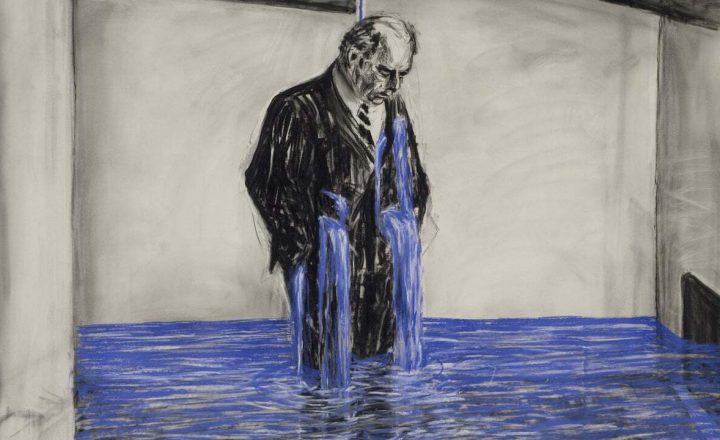
Brussels is reconnecting with one of the most singular artists on the international contemporary scene. Since 18 September 2026 and until 7 March 2027, the Palais des Beaux-Arts de Bruxelles, known as Bozar, is hosting William Kentridge for a major exhibition entitled “I am not me, the horse is not mine”. This retrospective traces an artistic journey begun in the early 1980s and deeply marked by the political and social upheavals of South Africa.
Born in 1955 in Johannesburg, William Kentridge developed his artistic language in the context of the struggle against the apartheid regime. His work gradually established itself as a reflection on the mechanisms of domination, racial injustices, political violence and the traces left by history on societies.
The exhibition brings together several forms of expression that characterize his approach: drawings, engravings, animated films, videos, sculptures and installations. It also gives an important place to his theatrical and operatic productions, revealing an artist who refuses to compartmentalize disciplines.
A return steeped in history to Brussels
This new presence at Bozar has a particular dimension. Brussels has maintained an artistic relationship with Kentridge for several decades. In 1995, the Belgian capital had hosted the creation of his opera “Faustus in Africa!”. Three years later, in 1998, Bozar presented his first institutional solo exhibition in Europe.
Nearly three decades after this first encounter with the Brussels public, the artist returns to a space that this time devotes a much broader trajectory to him. He is also involved on site through site-specific creations, notably a monumental wall drawing around the character of Ubu and a tribute to the South African dancer and choreographer Dada Masilo.
The retrospective is not limited to a chronological presentation of his works. Conceived as a musical composition, it connects different creative periods and creates a dialogue between images, historical narratives and stage experiences.
Art as an instrument of political memory
Beyond its aesthetic dimension, William Kentridge’s work questions societies about their relationship to the past. Apartheid is one of his main sources of inspiration, but his reflection goes beyond South African borders. It also addresses the legacies of colonialism, authoritarian regimes, migrations and relations of domination.
The artist uses drawing and animated cinema in particular to bring out complex, sometimes contradictory stories. His characters, sets and staging evoke political transformations, collective hopes and disillusionments that run through societies.
This approach also resonates with the history of relations between Europe and Africa. Kentridge has notably mentioned his interest in African colonial history and Belgium’s past in Congo. A dimension that gives particular resonance to his presence in the Belgian capital.
For the 2026-2027 cultural season, Bozar has also chosen the artist as its first “Grand Invité”, a program that goes beyond the framework of the exhibition and associates his universe with performances, concerts, encounters and artistic collaborations.
By hosting this retrospective, Brussels is therefore not only celebrating four decades of creation. It also opens a space for reflection on how art can question power, preserve the memory of injustices and contribute to understanding collective histories.
MB / TV5
About The Author

Commentaires