
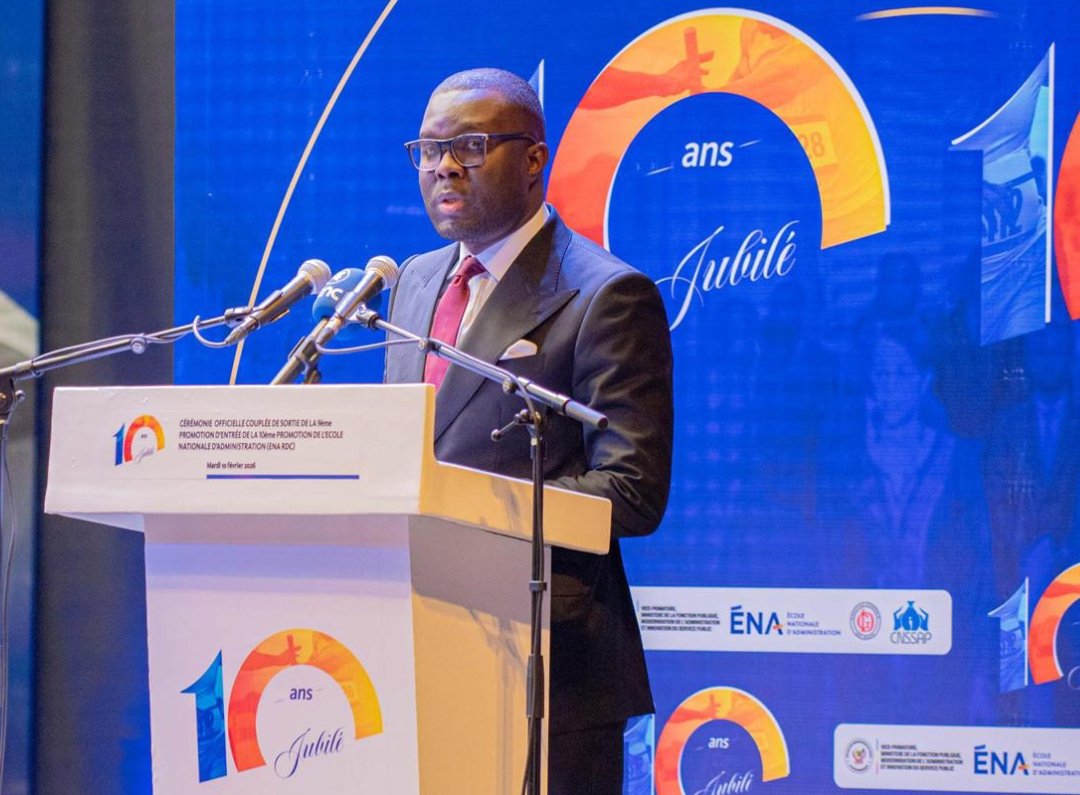
Since taking office as Director General of the National School of Administration, known as ENA, in December 2024, Cédrick Tombola has positioned the institution as a key driver of public sector transformation in the Democratic Republic of Congo.
Confirmed in his role by the President of the Republic, he quickly launched a strategic plan covering the 2025-2027 period. Its central ambition is clear: to reform the ENA in order to reform the State.
A school serving senior public administration
The ENA is best known for training senior civil servants. Since its creation in April 2013, it has trained 9 cohorts, representing 842 ENA graduates and civil administrators.
These professionals are now deployed across public administration, public services and political offices. Their mission is to strengthen state effectiveness, improve public service delivery and support the modernization of the Congolese administration.
However, for Cédrick Tombola, the ENA’s role must now go further. In addition to initial training, the school must become a major platform for continuous training, institutional advisory services and research.
Expanding continuous training
One of the main priorities of the new strategy is to broaden access to continuous training for state officials and public sector managers. The aim is to extend the ENA’s impact beyond its traditional cohorts and make its expertise available to the wider public administration.
This responds to a pressing need: strengthening technical skills in key areas of public management. The ENA has developed certified training programs aligned with international standards, including those of the Project Management Institute and PECB.
These programs target public administration staff, state-owned enterprises, public institutions and project management units.
A new financial model for the ENA
When Cédrick Tombola arrived, the institution was heavily dependent on government and donor funding. In 2023-2024, the school was almost at a standstill due to insufficient resources.
To address this, the ENA diversified its business model and began building a stronger financial foundation. The results have been significant: total revenues increased from around USD 1.7 million in 2024 to approximately USD 5.4 million for the 2025 financial year.
This progress reflects the institution’s ambition to become more financially autonomous while strengthening its ability to deliver on its public mission.
Transparency, governance and certification
The transformation of the ENA also involves stronger internal governance. For the first time in its history, the school has introduced financial accounting and is preparing to publish its financial statements for the year ending December 31, 2025.
The ENA has also obtained ISO 9001 certification for its quality management system from AFNOR. This certification marks an important step toward professionalizing the institution and adopting stronger management standards.
For a school responsible for training the country’s administrative elite, these reforms are essential. They reinforce the ENA’s credibility and allow it to embody the good governance practices it seeks to promote across public administration.
Partnerships to strengthen state capacity
The ENA has also developed several partnerships with national and international institutions. These include the General Inspectorate of Finance, the World Bank’s AGREE project, the Ministry of Mines, the National Equalization Fund and the Ministry of Finance’s UGP-MOD.
Between 2025 and April 2026, nearly 1,100 participants were trained through these initiatives.
The school has also created a database of trainers and experts from the DRC, France, Belgium, West Africa and partner institutions. A new partnership with Expertise France, supported by the French Development Agency, will further strengthen the ENA’s work in administrative governance.
Building the skills public administration needs
Cédrick Tombola’s assessment is direct: the Congolese administration still faces a significant shortage of technical skills in several key areas.
To respond, the ENA aims to train public officials at scale in cross-cutting fields such as project management, public procurement, contract execution and procurement control. These skills are essential for a developing country where the effective implementation of public projects remains a major challenge.
With support from the World Bank, the ENA is preparing to train public procurement specialists who will be deployed in project management units.
Decentralization, a new campus and research
The ENA’s priorities also include the construction of a new campus, the diversification of its training offer, wider access to continuous training and the development of research.
Another important area is decentralization. The ENA is preparing a support program to strengthen institutional capacity in the provinces, with partners such as ENABEL showing interest in supporting this initiative.
This provincial focus is strategic. Reforming the State cannot be limited to central administration. It must also strengthen capacity in the provinces, where public policies have a direct impact on citizens.
The ENA at the center of state reform
Through its 2025-2027 strategic plan, the ENA aims to become more than a training school. It seeks to become a center of excellence for certification, advisory services, research and institutional support.
For Cédrick Tombola, ENA graduates already represent an important pool of talent for the Congolese State. More than 95% of them continue to work within public services, political offices or public administration.
The challenge now is to expand this impact, train more public officials and help build an administration capable of supporting the development ambitions of the Democratic Republic of Congo.
About The Author

Commentaires