
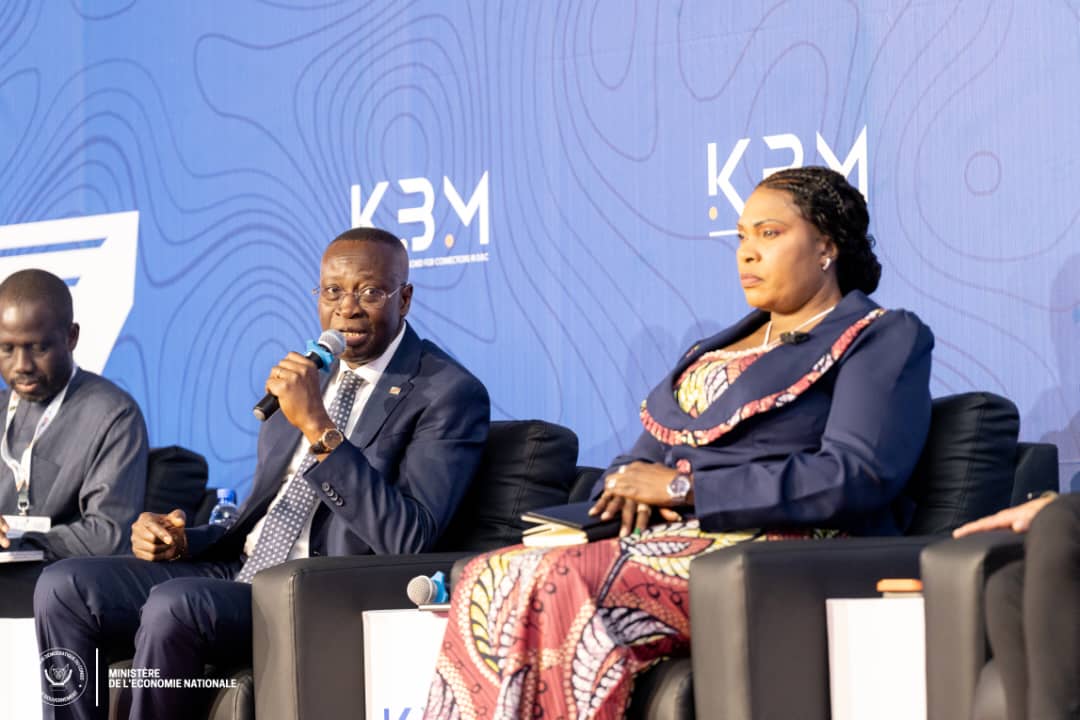
Speaking at the Katanga Business Meeting (KBM), Democratic Republic of Congo’s Deputy Prime Minister and Minister of Economy, Daniel Mukoko Samba, outlined the government’s economic priorities, focusing on infrastructure financing, public-private partnerships, state-owned enterprise reforms and the regulation of retail trade.
KBM as a platform for economic dialogue
Mukoko described the Katanga Business Meeting as an important platform bringing together government officials, private investors and development partners.
He emphasized that economic policies should reflect the specific realities of each province rather than applying a one-size-fits-all approach.
Maintaining prudent debt management
Despite significant infrastructure needs, the Congolese government continues to pursue a cautious borrowing strategy.
According to Mukoko, public debt remains relatively low—around 18–19% of GDP—providing the country with financial flexibility while protecting long-term macroeconomic stability.
He stressed that infrastructure development should rely not only on public borrowing but also on alternative financing mechanisms.
Public-private partnerships gaining momentum
The Deputy Prime Minister highlighted public-private partnerships (PPPs) as a key driver of future investment.
He pointed to major strategic projects such as the Banana Deep-Sea Port and Grand Inga as examples of increasing collaboration between the public and private sectors.
The government is also considering new partnership models in other strategic industries while preserving the role of state-owned enterprises where appropriate.
Gradual reform of state-owned enterprises
Mukoko acknowledged that reforming public enterprises remains politically and socially challenging.
He noted that reforms often face resistance but argued that successful examples are the best way to build public confidence.
He also revealed that additional reforms are being prepared for the national electricity utility (SNEL), aiming to liberalize selected market segments while protecting strategic activities.
The non-objection certificate explained
Addressing concerns from businesses, Mukoko clarified that the recently introduced Non-Objection Certificate (ANO) is not a new tax.
Instead, he described it as a regulatory mechanism designed to better organize retail activities under existing legislation while protecting Congolese small businesses.
A fully digital process
Applications for the ANO will be submitted online through the Ministry of Economy’s digital platform.
Authorities plan to process applications within a maximum of thirty days.
If no response is issued within that period, the application will automatically be considered approved.
A six-month transition period has also been introduced to allow existing businesses to comply with the new framework.
Balancing investment and local entrepreneurship
According to Mukoko, the reform seeks to protect small-scale Congolese traders while maintaining access for foreign investors in selected retail sectors requiring significant capital investment.
The government believes this balanced approach will improve the business environment while strengthening opportunities for local entrepreneurs.
About The Author

Commentaires