
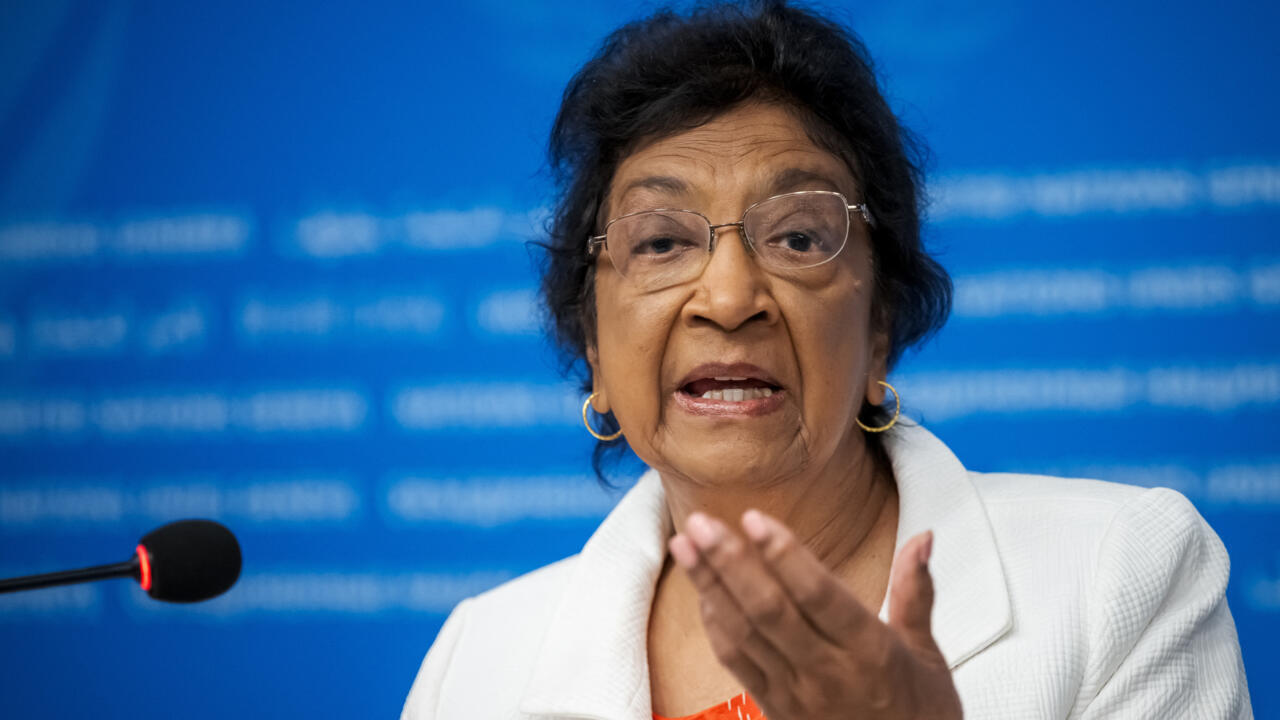
From the fight against apartheid in South Africa to the major international courts, South African jurist Navanethem “Navi” Pillay has devoted her career to defending human rights and the accountability of perpetrators of serious crimes. Her Nobel Peace Prize also highlights a file essential for the Democratic Republic of the Congo: the Mapping Report, which documents the violence committed between 1993 and 2003 and whose judicial recommendations remain largely unaddressed.
A career forged against discrimination
In 1967, she became the first woman to open a law practice in her home province of Natal. She defended anti-apartheid activists, denounced torture, and helped secure recognition of fundamental rights for detainees on Robben Island, among them Nelson Mandela. This early commitment foreshadows the guiding thread of her career: ensuring that the law protects people exposed to arbitrariness.
After the end of apartheid, she was appointed in 1995 to the High Court of South Africa, becoming the first non-white woman to sit there. In 1999, she joined the International Criminal Tribunal for Rwanda (ICTR), of which she became president. She contributed to a major advance: the recognition of rape and sexual violence as acts that can constitute crimes against humanity and, depending on the circumstances, acts of genocide.
From Rwanda to global jurisdictions
From 2003 to 2008, she was a judge at the International Criminal Court. She then served, from 2008 to 2014, as United Nations High Commissioner for Human Rights. In that position, she defended the universality of fundamental rights and recalled that both States and individuals can be held accountable for their acts. Since 2019, she has also served as an ad hoc judge at the International Court of Justice in the case brought by The Gambia against Myanmar under the Genocide Convention.
On 9 October 2026, the Norwegian Nobel Committee awarded her the Nobel Peace Prize for her efforts on behalf of peace and international law. It highlighted her courage, her integrity, and her contribution to the prosecution of war crimes, crimes against humanity, and genocide. The distinction rewards a career, but it also carries a message: lasting peace cannot rest solely on diplomatic agreements if the most serious crimes remain unpunished.
The Congolese file: the Mapping Report
For the DRC, the name Navi Pillay points to the Mapping Report of the United Nations Office of the High Commissioner for Human Rights. Published on 1 October 2010, this 550-page document lists 617 incidents among the most serious violations of human rights and international humanitarian law committed in the DRC between March 1993 and June 2003. It covers a period marked by wars, massacres, population displacements, sexual violence, and destruction of property.
One of the most sensitive passages concerns the possibility that certain acts, if their systematic nature and the required intent were established before a competent jurisdiction, could be qualified as crimes of genocide. This conditional wording is essential: the report did not judicially declare that a genocide had been committed. It underscored the gravity of the documented facts and the need for an assessment by an authorized body.
The document recommends in particular justice mechanisms suited to the scale of the violations. More than fifteen years after its publication, the question of the criminal responsibility of the main alleged perpetrators remains a major issue.
From Gaza to the DRC, the demand for accountability
Between 2021 and 2025, Navi Pillay chaired the United Nations Independent International Commission of Inquiry on the Occupied Palestinian Territory, including East Jerusalem, and Israel. In September 2025, that commission concluded that Israel had committed genocide in Gaza. Israel rejected those conclusions. A distinction should be made between the finding formulated by a commission of inquiry and the definitive establishment of criminal responsibility by a court: the two processes have neither the same mandate nor the same legal scope.
The DRC is directly concerned by this debate. The country has experienced successive conflicts and massive violations, while expectations for justice remain high in the regions affected by the violence. The Mapping Report remains a documentary reference, but it replaces neither the investigations, nor the trials, nor the reparations awaited by the victims. Its scope depends on the willingness of national and international institutions to give concrete follow-up to its recommendations.
A distinction that goes beyond one person
Her career links apartheid-era South Africa, post-genocide Rwanda, and the international institutions responsible for responding to mass crimes. For the DRC, the reminder is particularly strong. The Mapping Report has preserved the memory of much suffering and raised the question of the judicial avenues to be mobilized. The challenge is to transform this documentation into credible proceedings, respectful of the rights of the defense and capable of delivering justice.
By honoring Navi Pillay, the Nobel Committee defends the idea that an international order founded on law remains indispensable to peace. For Congolese victims, this recognition will have a lasting impact only if it helps keep the question of responsibility open and revive the demand for justice. The stakes are not only to commemorate the crimes of the past, but to prevent their repetition.
Héritier Maila
About The Author

Commentaires